


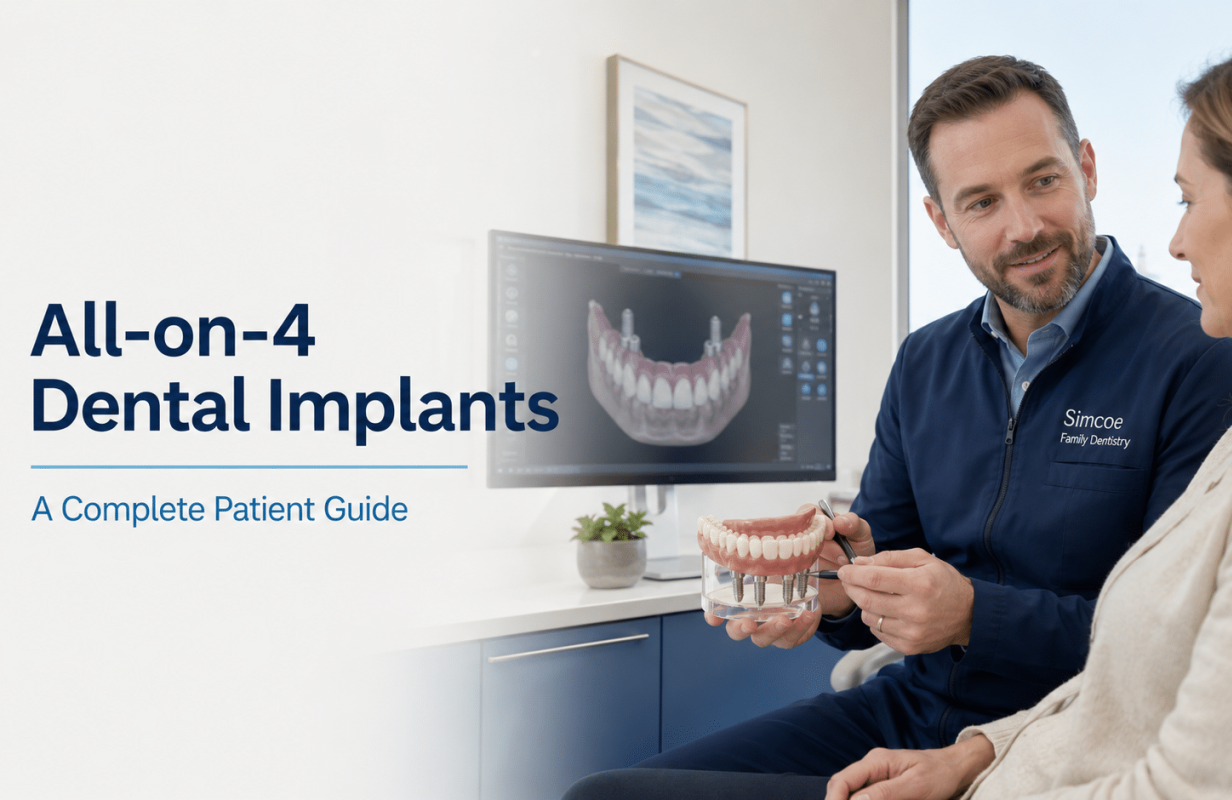
All-on-4 Dental Implants: A Complete Patient Guide
Living with many missing or failing teeth can affect how you eat, speak, and feel about everyday activities. For some adults, All-on-4 dental implants may provide a way to replace a complete upper or lower arch of teeth with a restoration supported by dental implants.
This guide explains what All-on-4 treatment is, how the process generally works, who may be a candidate, and what patients should consider before choosing treatment. Every patient is different, so a clinical examination and diagnostic imaging are necessary before a dentist can recommend an appropriate option.
What Are All-on-4 Dental Implants?
All-on-4 is a full-arch tooth-replacement approach. Rather than using one implant for every missing tooth, a dentist places a planned number of implants – commonly four – to support a full bridge of replacement teeth in one arch.
The implants are placed in the jawbone and act as anchors for the restoration. The exact number, position, and angle of implants can vary according to a patient’s anatomy and treatment needs. Some cases require more than four implants or a different treatment approach.
All-on-4 treatment may be considered for the upper arch, lower arch, or both arches.
How Is All-on-4 Different From Traditional Dentures?
A traditional removable denture rests on the gums and is taken out for cleaning. An All-on-4 restoration is supported by implants and is generally fixed in place by the dental team. It does not rely only on the gums for support.
Potential differences may include:
- Greater stability while speaking and eating
- No daily denture adhesive in most cases
- A restoration that is not removed by the patient each night
- Different cleaning techniques and maintenance requirements
- A surgical procedure and healing period
- A higher initial cost than conventional removable dentures
Neither option is right for everyone. Health, anatomy, goals, maintenance needs, and budget should all be discussed during a consultation.
Who May Be a Candidate?
All-on-4 treatment may be considered for an adult who:
- Is missing all or most teeth in one arch
- Has teeth that may no longer be predictably restored
- Has difficulty wearing a removable denture
- Has enough suitable bone to support implants or qualifies for an adapted treatment plan
- Has healthy oral tissues or can have existing disease treated
- Is medically able to undergo implant surgery
- Is willing to maintain careful oral hygiene and attend regular follow-up visits
Factors such as active gum disease, uncontrolled diabetes, certain medical conditions or medications, severe bone loss, poor oral hygiene, and smoking or vaping can affect healing or implant success. These factors do not automatically produce the same decision for every patient, but they require careful assessment and discussion.

What Happens During Treatment?
1. Consultation and assessment
The process begins with a review of your dental concerns, health history, medications, expectations, and treatment goals. The dental team examines your mouth and may use X-rays, photographs, digital scans, or three-dimensional imaging to evaluate the teeth, gums, bone, nerves, and sinuses.
2. Personalized treatment planning
Your dentist develops a plan that may address tooth removal, implant placement, the type of restoration, sedation or anaesthesia options, anticipated healing, fees, and alternatives. If additional procedures are needed, they should be explained before treatment begins.
3. Implant placement
During surgery, any planned extractions are completed and the implants are placed in selected areas of the jaw. Depending on the case and implant stability, a temporary fixed restoration may sometimes be attached during the early treatment stage. Immediate placement or loading is not appropriate or possible in every case.
4. Healing
The bone and implants need time to integrate. Patients receive instructions about food choices, oral hygiene, medications, and follow-up appointments. Healing times vary according to the procedure, health factors, and individual response.
5. Final restoration
After appropriate healing and assessment, records are taken for the final bridge. The dentist checks its fit, bite, appearance, function, and cleansability before completing treatment.

Potential Benefits
Depending on the individual case, possible benefits may include:
- Replacement of a complete arch of teeth
- Improved stability compared with a conventional removable denture
- Support for chewing and speaking
- A restoration designed for the patient’s bite and facial features
- Fewer implants than some other full-arch implant approaches
- No need for the patient to remove the fixed bridge each night
Results and experiences vary. Dental implants and restorations also require ongoing care and may need repair, maintenance, or replacement over time.
Risks and Important Considerations
All-on-4 treatment involves surgery and is not risk-free. Possible complications can include infection, bleeding, swelling, discomfort, injury to nearby teeth or tissues, nerve-related symptoms, sinus complications in the upper jaw, implant failure, bone loss, gum inflammation, bite problems, or loosening or damage to parts of the restoration.
Some complications can occur during healing, while others may develop later. Your dentist should explain the risks that apply to your specific anatomy and medical history, along with reasonable treatment alternatives.
Recovery After Treatment
Temporary swelling, bruising, tenderness, and changes in chewing may occur after implant surgery. The dental team will provide case-specific aftercare instructions. These may include using prescribed or recommended medications correctly, choosing softer foods temporarily, keeping the area clean, and avoiding pressure on the healing implants.
Contact the treating dental office if symptoms are severe, worsening, unexpected, or concerning. Follow-up visits are important even when recovery appears to be going well.
How to Care for an All-on-4 Restoration
Implant-supported teeth cannot develop cavities, but the gums and bone around implants can become inflamed or infected. Daily cleaning and professional maintenance remain essential.
Your dental team may recommend:
- Brushing at least twice daily with an appropriate toothbrush
- Cleaning beneath the bridge with floss threaders, interdental brushes, a water flosser, or other recommended tools
- Attending regular dental hygiene and implant-maintenance appointments
- Having the implants, gums, bridge, and bite checked periodically
- Wearing a night guard when recommended
- Avoiding habits that can overload or damage the restoration
Maintenance instructions should be customized to the design of your restoration and your oral health.
All-on-4 Compared With Other Options
Other possible treatments may include a conventional removable denture, an implant-retained removable overdenture, an implant-supported fixed bridge using a different number of implants, or restoration of remaining natural teeth where appropriate.
Each option has different clinical requirements, costs, benefits, risks, and maintenance needs. A thorough consultation should include the reasonable alternatives available in your case—not only one treatment.

Frequently Asked Questions
Are All-on-4 teeth removable?
The restoration is generally fixed to the implants and is removed by a dental professional when clinically necessary. It still needs daily cleaning, including cleaning beneath the bridge.
Can I receive temporary teeth on the day of surgery?
Some patients may qualify for a temporary fixed restoration soon after implant placement. This depends on bone quality, implant stability, the planned procedure, bite forces, and other clinical factors. It cannot be promised before assessment and surgery.
Is the procedure painful?
Local anaesthesia is used to manage discomfort during surgery, and additional options may be discussed when appropriate. Tenderness, swelling, and bruising can occur afterward. The type and degree of discomfort vary among patients.
How long does All-on-4 treatment take?
The timeline varies. Consultation, imaging, planning, surgery, healing, trial stages, and delivery of the final restoration may take place over several appointments and months. Your dentist can provide a more useful estimate after evaluating your case.
How long do All-on-4 implants last?
No implant or restoration can be guaranteed for life. Longevity depends on health, healing, oral hygiene, professional maintenance, smoking or vaping, bite forces, and other factors. The bridge or its components may require repair or replacement even when the implants remain stable.
Will I need bone grafting?
Not every patient needs grafting, but some do. Imaging and clinical evaluation help determine whether the available bone can support the proposed treatment.
Can I eat normally afterward?
Food restrictions are usually required during early healing to reduce pressure on the implants. The treating dentist will explain when and how to progress your diet. Long-term chewing function depends on healing, restoration design, and individual clinical factors.
How much does All-on-4 treatment cost?
Fees vary based on the number of arches treated, diagnostic needs, extractions, implant and restoration design, materials, additional procedures, and follow-up care. A written treatment plan should outline the recommended services and associated fees after an examination.
Take the Next Step
If you are exploring options for several missing or failing teeth, an implant consultation can help you understand whether All-on-4 treatment—or another solution—may suit your needs.
Book a consultation with Simcoe Family Dentistry to receive an individualized assessment, review your options, and ask questions about treatment, recovery, maintenance, and fees.
This article provides general information and is not a diagnosis or a substitute for professional dental advice. Treatment recommendations, timelines, risks, outcomes, and costs vary by patient. A dentist must examine you before recommending treatment.